The SambaNova Advantage
GPUs weren't built for AI. They were designed for video game graphics, and the architecture shows. SambaNova took a different path, designing chips purpose-made for AI inference from the ground up. Independent benchmarks show up to 10x faster inference, making it the fastest LLM inference technology available. Here's how it works.
GPUs Spend Most of Their Time Waiting
When a GPU generates AI responses, it follows a repetitive cycle: fetch data from memory, compute, write back to memory, repeat. The round trip to memory takes far longer than the actual computation. GPUs spend most of their time waiting for data, not processing it.
Engineers call this "memory-bound." The processor idles while data shuffles back and forth. For AI inference, where every token requires this fetch-compute-write cycle, the delays stack up. A 1,000-token response means 1,000 memory round trips.
GPU manufacturers have tried faster memory and bigger caches. The core problem remains: data keeps bouncing between processor and memory.
Dataflow Streams Data Through the Chip Instead of Shuffling It
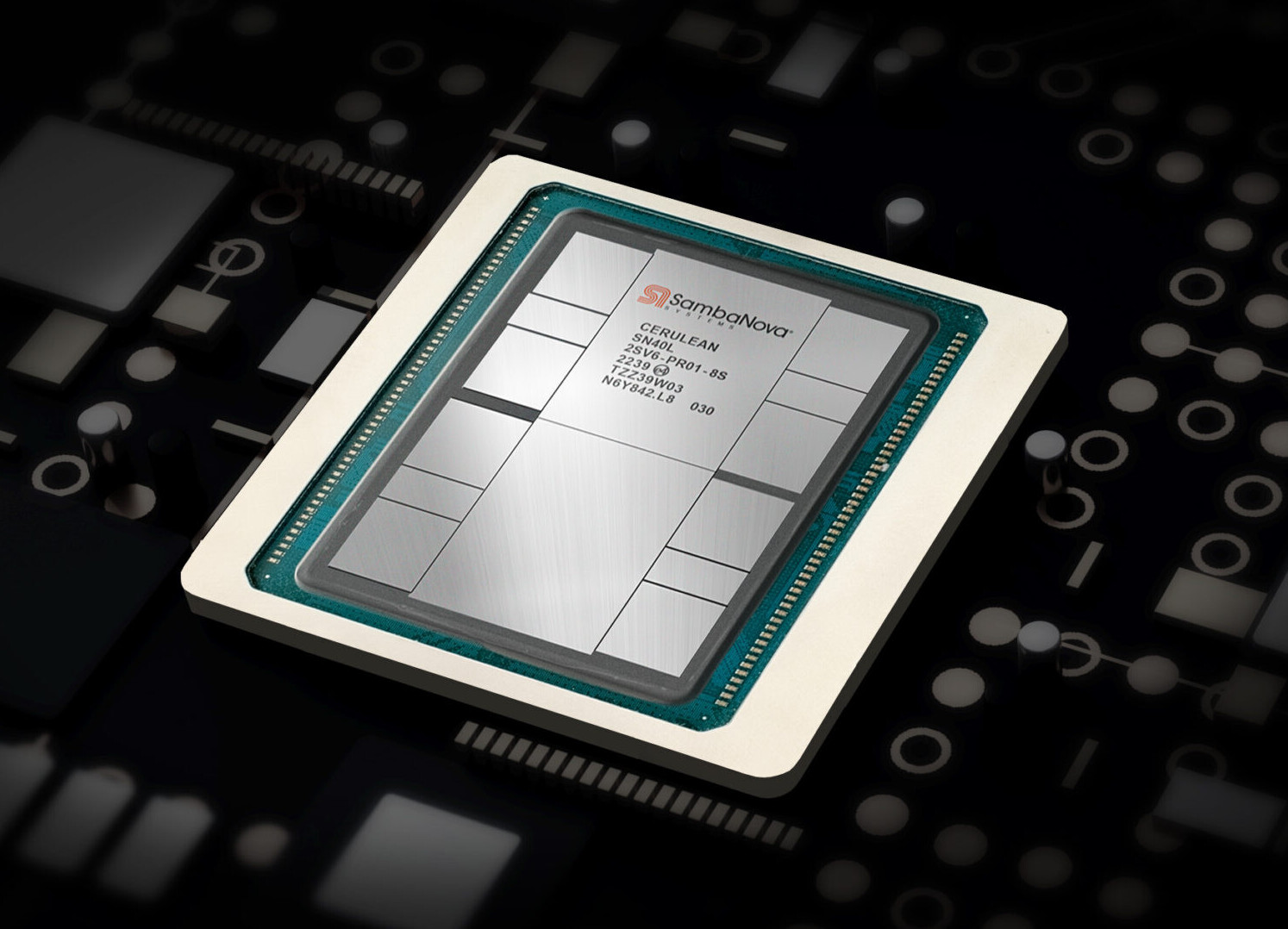
SambaNova's Reconfigurable Dataflow Units (RDUs) work differently. Instead of fetching and storing data repeatedly, they lay operations out spatially across the chip and stream data through them continuously. Data moves in one direction through the computation, like parts on an assembly line, rather than being loaded and unloaded at each step.
The entire AI model stays resident in memory. Data flows through operations without intermediate writes. Operations that would require separate steps on a GPU get fused together. SambaNova calls this "execution streaming continuously across the processor." It's the opposite of kernel-by-kernel GPU execution.
Less waiting. More throughput.
A Three-Tier Memory System Lets One Rack Run 600B+ Parameter Models
SambaNova uses a three-tier memory hierarchy that balances speed and capacity. At the fastest level, 520 megabytes of SRAM sits directly on each chip, handling the hottest data and enabling operations to fuse together without memory trips. Below that, 64 gigabytes of high-bandwidth memory (HBM) holds model weights and active data. Unlike traditional caches, this layer is software-controlled, meaning the system decides exactly what lives here rather than relying on automatic eviction policies.
The third tier provides up to 1.5 terabytes of DDR memory per chip for prompt caching and hosting multiple models simultaneously. Each chip can address memory across all chips in the rack, creating a massive shared memory pool that operates as a flat address space.
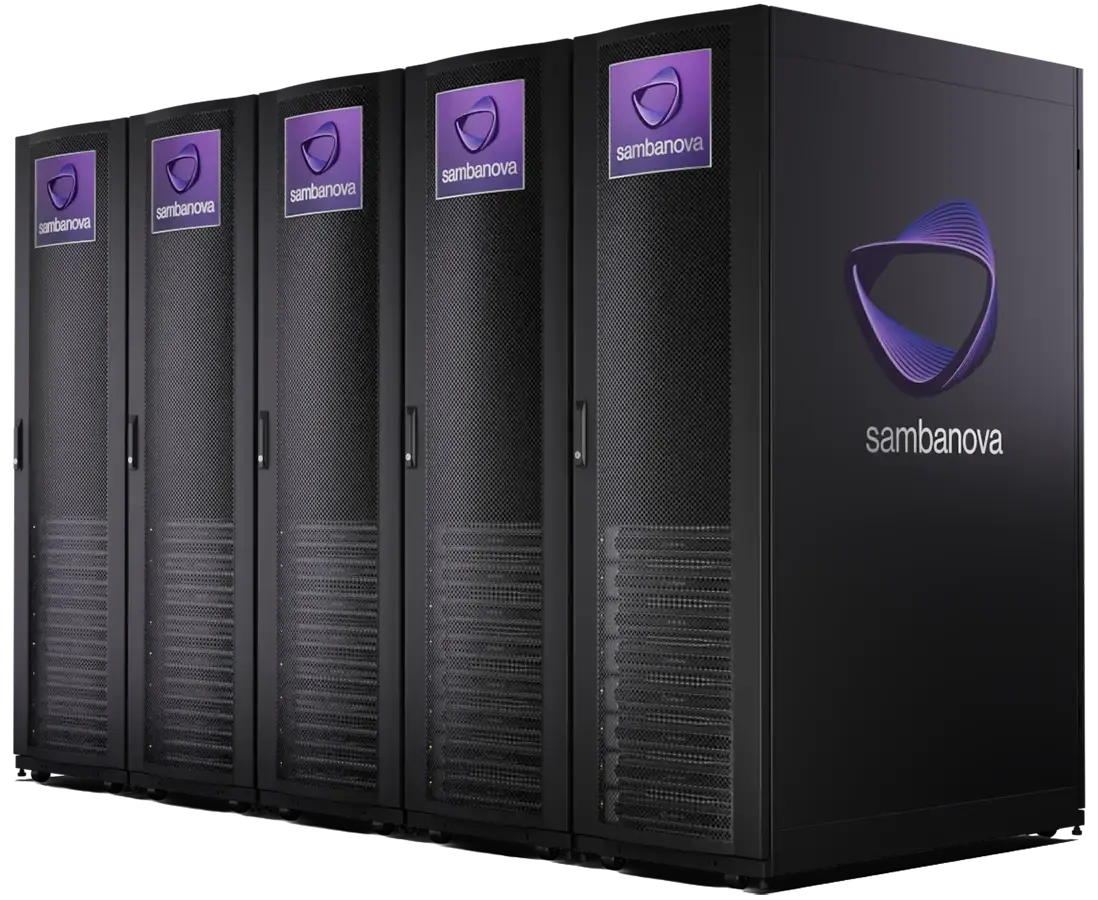
A single rack can run models with hundreds of billions of parameters. Competitors using pure SRAM architectures need thousands of chips to achieve the same capability. The three-tier approach trades a small amount of peak speed for better capacity and flexibility.
Up to 10x Faster Than GPU Inference, 5x Better Energy Efficiency
Independent benchmarks from Artificial Analysis confirm the performance difference: SambaNova's dataflow architecture delivers up to 10x faster inference than GPU alternatives, with up to 5x better energy efficiency. A single rack consumes around 10 to 15 kilowatts versus 40 to 50 kilowatts or more for equivalent GPU infrastructure. It runs on standard air cooling, requiring no exotic liquid cooling systems or purpose-built datacenters.
For real-time applications, this shows up in the user experience. An AI assistant that responds in 200 milliseconds instead of 2 seconds is a different product. You use it constantly instead of waiting for it. Faster tokens also mean more reasoning steps within the same time budget, which matters for agentic workflows and complex multi-step tasks.
SambaNova Technology in Europe: Infercom is the First and Only Public Provider
All of this performance is available through SambaNova's cloud. But that cloud runs in the United States. For European businesses with GDPR compliance requirements, data sovereignty mandates, or a preference to keep sensitive data within EU jurisdiction, that creates a barrier.
Infercom brings SambaNova to Europe. We operate the first and only public SambaNova cloud in the EU, hosted in Munich, Germany. Latency from Frankfurt is under 10 milliseconds. With speeds exceeding 400 tokens per second on models like MiniMax M2.7 Ultraspeed, it's the fastest LLM API in Europe — with complete EU data sovereignty. Your prompts and responses never leave European soil. No CLOUD Act exposure. No third-country data transfers. Fully GDPR compliant.
If you're building AI applications that need both speed and sovereignty, this is the infrastructure.
Want to go deeper?
Further Reading: Technical Papers & Benchmarks